
What Would Jesus Do (Contemplating A Vaccine)?
In which recent discoveries in genetics make clear how vaccination is an act of love.

We’ll get to the question above—what would Jesus do if confronted with a syringe?—but by a bit of a twisty way ‘round. We’ll start with some fascinating science news that might seem at a bit of remove from speculation about the thoughts and deeds of a carpenter from Galilee. Don’t worry. We’ll get back here in moment.
Yesterday, Diane Kwon published a report in Nature that wrestled with an obvious but often overlooked mystery: why do some people sicken and die from an infection with bugs that are harmless to most of us?
Kwon lead her story with the tale of a boy who was brought to a London hospital already desperately ill. Nothing the doctors there could do checked his disease, and he ultimately died of an infection by Mycobacterium fortuitum, a bacterium found in water and soil that for the most part cohabits with humankind perfectly peacefully. So what made it deadly to that particular child?
It took several years but researchers were able to nail down the culprit: a mutation affecting a specific step in his immune system’s response to a microbial invader.
One by one, such genetic alterations can be quite rare—but it turns out that there are a lot of ways that changes in our genes can cause what have been named “inborn errors of immunity.” That means that the number of people suffering some deficit in their ability to fight off infection reaches into the millions.
These discoveries reaffirm one of the most critical 20th century developments in the germ theory of disease. The initial “central dogma” of the new theory was that one pathogen produces one disease (which is true) and that disease is a more or less consistent phenomenon.
That part’s not so solid. It’s easy to see that different people do not have the same experiences of various maladies, which ultimately suggested to researchers that the disease process couldn’t be a simple cause and effect transaction. Instead, it could be better understood as an dance between a pathogen and its target, the human host.
Yesterday’s report in Nature is an update on what researchers know so far about what shapes that interaction, why some people are unaffected by germs that pose a deadly threat to others. Crucially such differences don’t just affect a handful of people. It turns out that there are a lot of genetic variations that increase the danger from known pathogens, including (usefully for the purpose of this essay) Neisseria meningitidis, the bacterium that causes meningococcal disease.
N. meningitidis makes this something more than a tale of potentially useful basic research. It takes us back to the question at the head of this piece: what Jesus might do in a world where some people are going to be especially vulnerable to one particular germ or another?
A choice of one action or another emerges because there’s a vaccine that can block an N. meningitidis infection, safeguarding its users from meningococcal disease. Hence the question: would Jesus get the shot? Or Hillel, for that matter, or the spiritual leader of your choice?
I’m no theologian; far from it. I would not presume to place my words in ancient sages’ mouths. But I am willing to bet that it’s extremely unlikely that they would have affirmed what Robert F. Kennedy Jr. and the Trump administration just did: remove the inoculation against N. meningitidis from the schedule of recommended childhood immunizations (along with several other previously recommended vaccines). Meningococcal disease is a vicious affliction — it kills 10 percent or more of hospitalized patients — and it is a truly dire threat to those whose immune systems cannot respond vigorously to that infection.
Every vaccine received can thus save a life. The Jewish tradition holds that to save a life is to save a universe; other systems of belief have similar framings. As for Jesus himself, he said, “Truly I tell you, whatever you did not do for one of the least of these, you did not do for me” (Matthew 25:45)—which in this context can reasonably be read as whatever shot you did not get to protect others puts me in harm’s way as well.
I confess: I’m beating a drum I’ve struck before and will hit again: vaccination is first and foremost something one does for oneself (and one’s kids.) Getting the measles when you don’t have to is miserable even if it doesn’t kill you (and it can). COVID vaccines aren’t perfect, but they reduce the risk of both severe disease and death. The smallpox vaccine saved its recipients from one of the most terrifying infectious scourges ever to strike humanity, and so on.
But as great as such protection is for a single individual, vaccines are gifts we give each other. They bind up the web of society with love. Every shot I accept means that a pathogen has a harder road to travel to find another host; strangers I will never meet get some mote of extra protection because I bared my arm to the needle. Every jab you receive does the same for me. That kindness redoubles for those more in danger than the common run of humanity, people whose luck-of-the-draw variations in their immune system can put them at lethal risk if, say, N. meningitidis finds its way to them.
I want to live in a community, a nation, a world that celebrates such kindness.
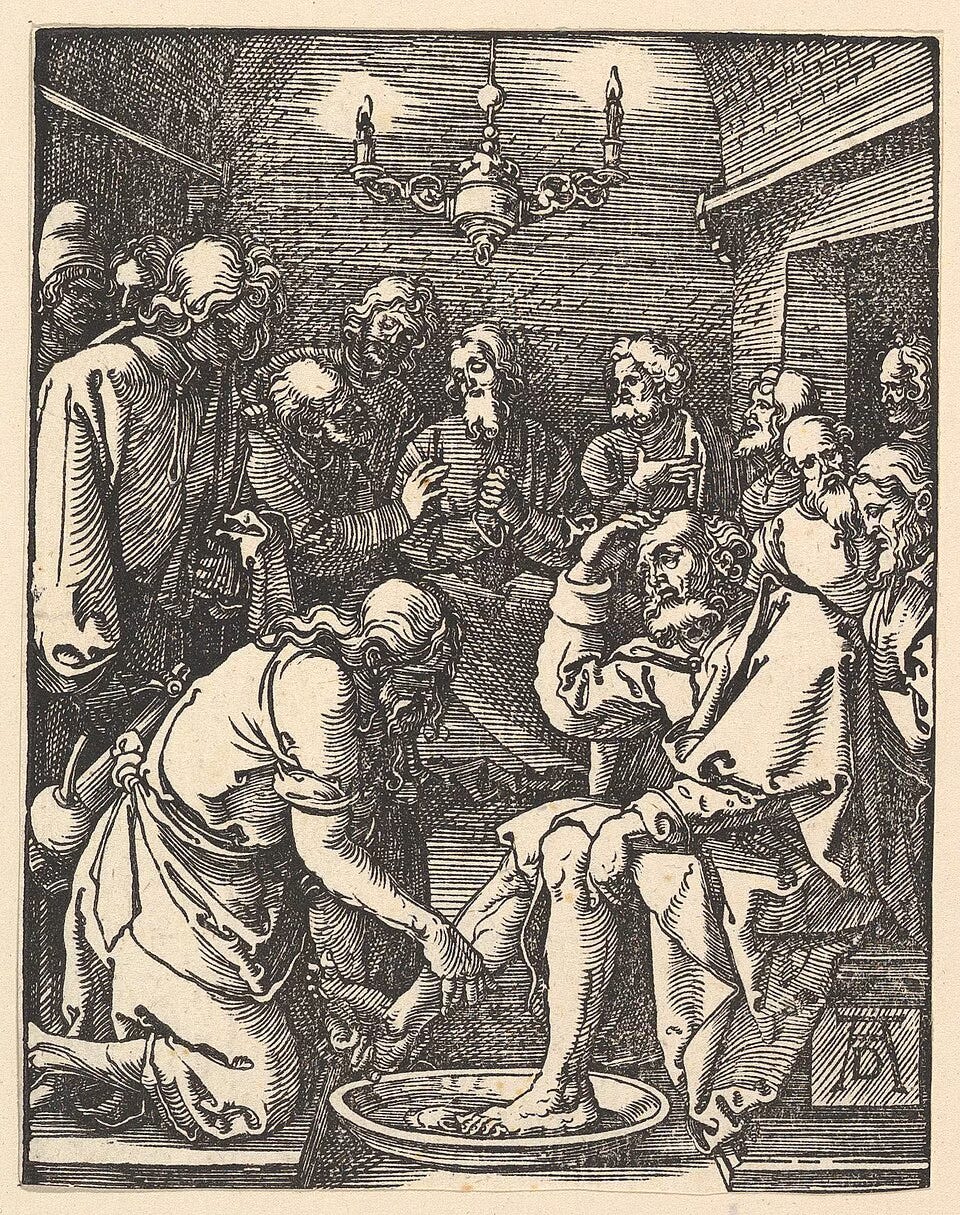
Image: Albrecht Dürer, Christ washing the disciples feet, c. 1508

Excellent article. I am reminded of Susan Sontag and "Illness as Metaphor". Disease used to mean something ("AIDS is punishment from god") and your survival of it was some type of badge of honor (measles, polio). 500 years of science have put all that to rest. I think people didn't like how quickly science was able to deal with COVID. Suddenly disease is just humans coming into contact with viruses and bacteria and not some verdict from above.
Good points. Sadly we seem to have discarded the notion that we should trouble ourselves to do things that might benefit society as a whole. Not all of us, but enough of us that those pathogens can keep on trucking, through host after host.