
Sunday Respite Notes
Reading as joyful resistance

First off—I’m hoping to make this a recurrent, if not exactly regular feature here at Inverse Square. The “this” being a moment spent with some writing (not mine) that can do what art does: create a common experience of feeling, thought, insight, knowledge, severally or all at once, that the artist and a person encountering their work can share. (Co-create even. The artist makes the work, but the work isn’t fully made until it encounters and engages someone else’s imagination. Or so it seems to me.)
THAT’s a ton of verbiage to consume on a Sunday, so let me just get down to it, taking a look at some good stuff that’s been making me feel and think recently.
First up: Philip Pullman’s The Rose Field. This is the third volume of the second trilogy set in Lyra Belacqua/Silvertongue and Pantalaimon‘s universe (or rather a universe centered on Lyra and Pan’s world but that also encompasses ours and other realities).
This trilogy doesn’t have the same glorious shock of the first, His Dark Materials, and especially the opening volume, The Golden Compass. There, Pullman brings us his utterly strange and fully realized vision of personhood composed jointly of a human and their daemon, an animal expression of the self that is an equal partner in each individual’s journey through life. That world coheres from the first scene; Pan and Lyra are convincingly one whole being from the start. It’s at once a bravura example of world building and an amazingly rich driver of the emotional and intellectual investigation Pullman undertakes.
That’s all still there in the later work, of course. Lyra and Pan remain the protagonist(s). Interactions between two material expressions of a single person drive both the plot and themes Pullman gives us. But it isn’t a surprise anymore; six volumes in that’s just the way it is (which is a measure of the creative accomplishment). Yet I’m still thrilled at the work—and it is in some sense because of that familiarity, not despite it.
What I’m mostly thinking and feeling at this point in my reading (I’m about 3/4s of the way through The Rose Field) is how much Lyra and Pan’s alienation from each other (remembering that they are the same person) reminds me of the need for something that’s harder and harder for me to give at this particular moment in this world. That would be the robust exercise of empathy, of a commonality of feeling —and hence a duty of care—with and for self and others. I am routinely unkind to myself. And though I hope I’m not actively mean to anyone around me, I know that I am regularly unaware of and unavailable to near and far. Pullman and Lyra and Pan and Matthew and Ionides and the rest do not instruct; they don’t tell me what to about distance or loss or how to do it (the problem that bedevils several of the one/two protagonists throughout the book). They do, or rather they have made me feel a reflected sense of their troubles, which makes me study my own circumstances. Can’t ask more of an artist or their work.
Plus…it’s a fabulous, galloping plot across an endlessly fascinating landscape. What’s not to like?
And second, more briefly because I’m much less far along, a new release: Is a River Alive? The book keeps reminding me that Robert Macfarlane is as close to an essential writer as I can think of right now. His work straddles the turf between nature and adventure writing and has always been shot through with a deep moral questions. I think I need to write a longer reflection on the way the books of his I’ve read so far have taught me both new stuff—facts and ideas—and new tools, ways to approach the craft of writing.
For now, let me just say that Is a River Alive is absolutely worth your time. It opens with a question and a challenge: can we learn how to think of our world as a place in which rights and hence obligations can inhere in something other than just people, or even animals. Can the natural world, can ecosystems, can landscapes exert a moral claim on us? Do such claims exist in themselves—not as a gift we bestow and could withdraw, but as an essential property within a social vision that encompasses both ourselves and the places and natural systems we inhabit and require for survival?
What makes this more than an abstract question is Macfarlane’s great gift—his ability to bring place and non-human events and agency to life in detail and tragic and uplifting beauty…in words. TL:DR—the man can really write.
That’s enough for now. I hope this is a useful or at least a pleasantly diversionary note. Let me know in the comments if you’d like more of these from time to time.
Cheers.
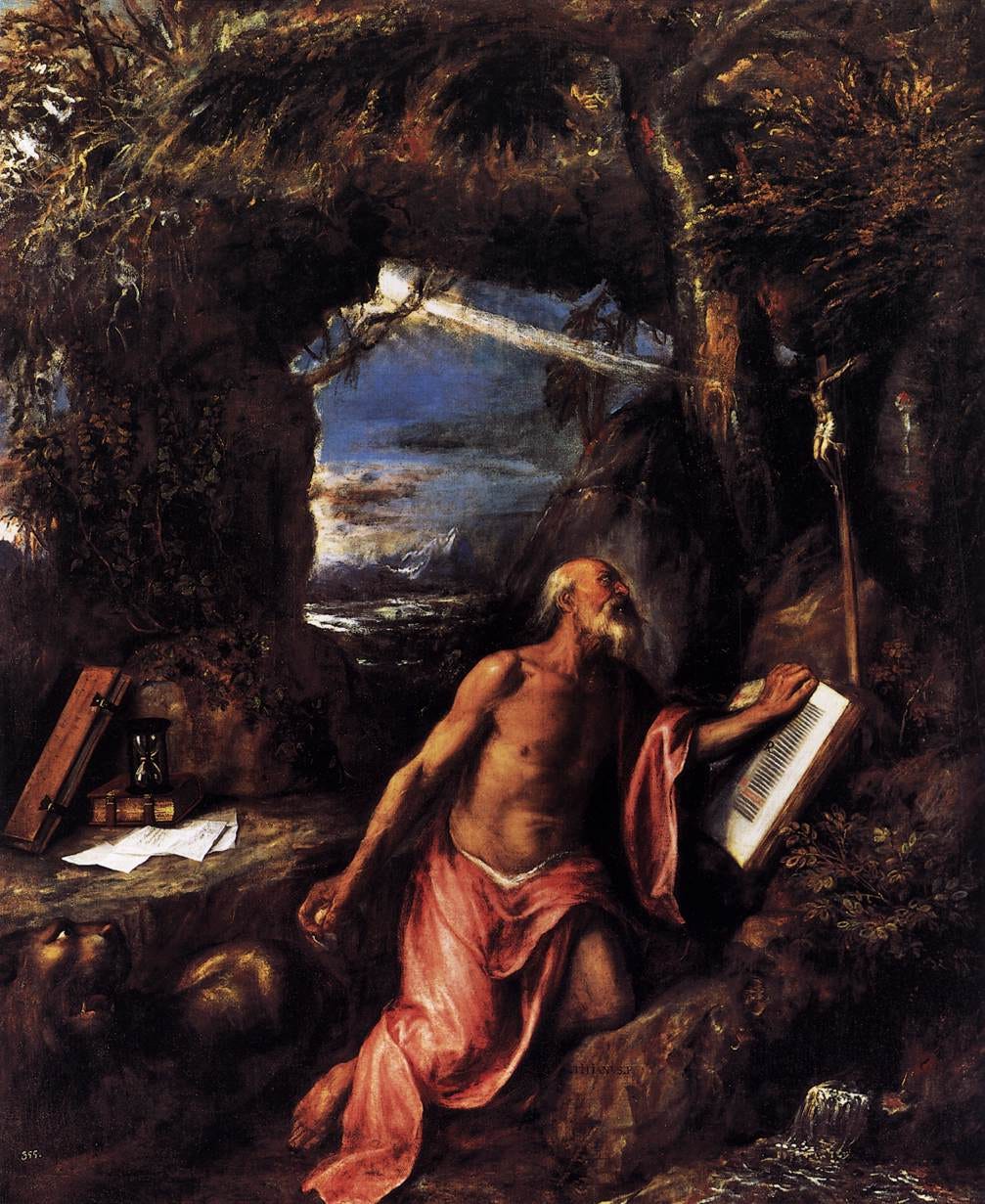
Image: Titian, St. Jerome [and his lion], c. 1575
![St. Jerome [and his lion]](https://commons.wikimedia.org/wiki/File:Titian_-_St_Jerome_-_WGA22839.jpg)
I've heard good thinks about some of these books, so based on your post I'll now seek them out as soon as I finish my current series read of Peter Tremayne's Sister Fildema medieval mysteries.
I've not gotten into The Rose Field, but I do remember the feeling of just being blown away by Pullman's Dark Materials trilogy. I'll have to check it out!
And yes, Robert MacFarlane. I loved Wild Places, and Elizabeth has a copy of Is A River Alive? and is reading it now. I plan to grab it when she is finished, and look forward to reading it.
Speaking of Elizabeth, and hearing that MacFarlane is on your reading list, you might enjoy some of her books of essays. She shares MacFarlane's fascination with landscape, and her thoughts about our relationship to the natural world go in some fascinating directions (but I might be biased...). But if you can get a copy of Horizon's Lens (2012) or In The Mind's Eye (2008) or Prospect (2003), I think that they might find traction as well.